Shell of Its Old Self
In 1945 the Willow Run bomber plant emptied. The government interviewed nearly all seventeen thousand workers on their way out; then, in the columnist's word, they melted away. When the plant came back in 1946 as the Kaiser-Frazer automobile works, the story had names — two industrialists, a banker, a magazine, fifty-three million dollars. This is the gap between what a place remembers by name and what it remembers by the thousand.
View the original at the Library of Congress →
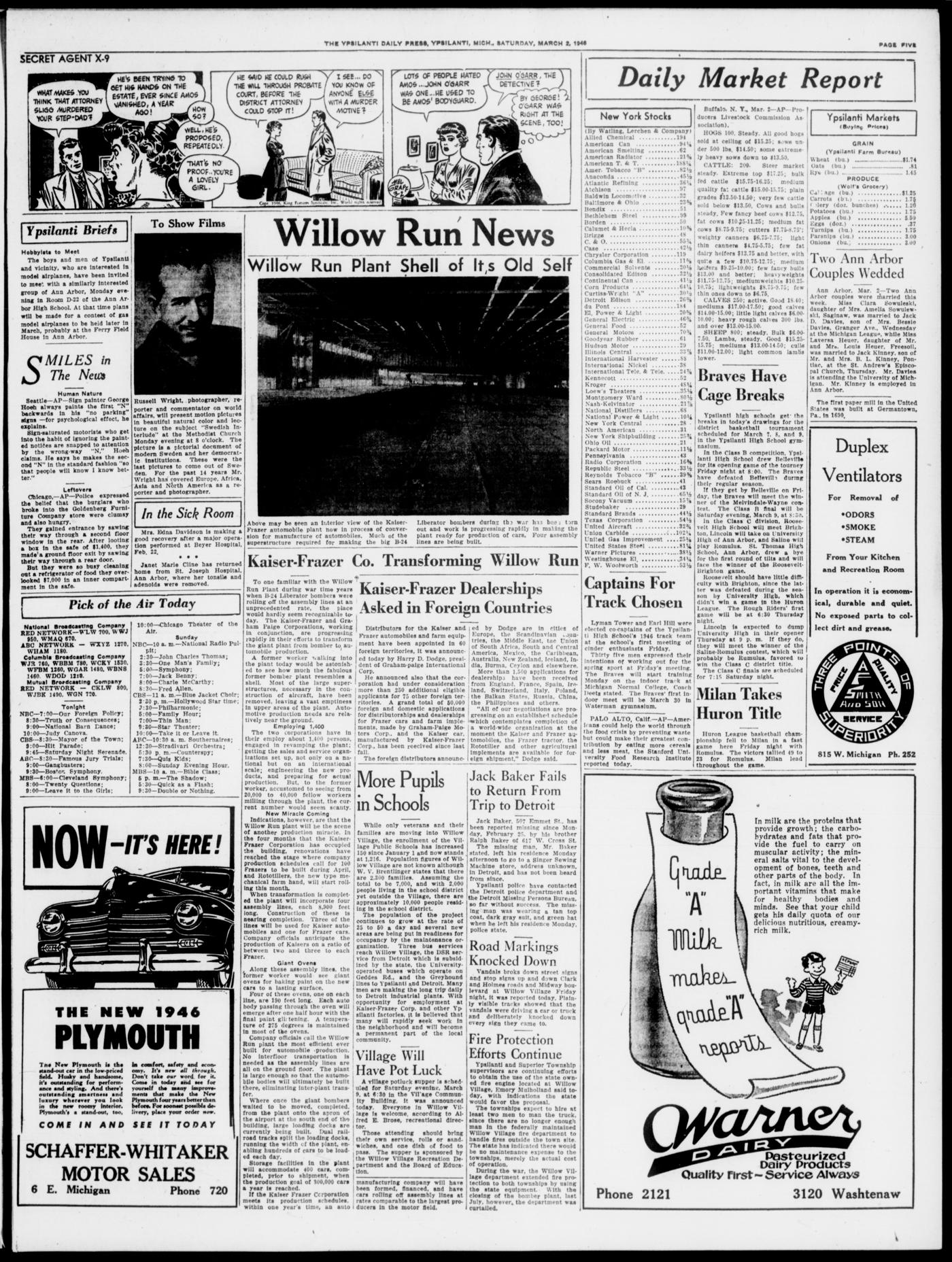
On the second of March, 1946, the Ypsilanti Daily Press ran a photograph of the inside of the Willow Run plant, and printed under it the plainest sentence it had ever printed about the place: the plant was a “Shell of It’s Old Self.”
This is the same plant that, four years earlier, this publication watched rise on a soybean field — the bomber works, and the migration it pulled in faster than the county could house it. That was the arrival. This is the departure. And the two are told in strikingly different registers, because the paper had names for one of them and not the other.
The photograph showed the emptiness. “Much of the superstructure required for making the big B-24 Liberator bombers during the war has been torn out,” the caption read, and work was going on “in making the plant ready for production of cars.” To anyone who had known it in “war time years when B-24 Liberator bombers were rolling off the assembly lines at an unprecedented rate,” the paper wrote, the place “would hardly seem recognizable today” — the former bomber plant now “resembles a shell,” its superstructure removed, “leaving a vast emptiness in upper areas of the plant.”
And then the paper set down the number that is the whole of this story. The two automobile corporations now working in the building, it reported, “have in their employ about 1,400 persons.” But to the former worker, “accustomed to seeing from 20,000 to 40,000 fellow workers milling through the plant, the current number would seem scanty.”
Fourteen hundred, where there had been forty thousand. That is what happened to Willow Run. The rest of the record is who got named.
The names
The buyers arrived with their names in headlines. Two days after the shell photograph, the same Daily Press section ran a second story — “Where Henry Kaiser, Joseph Frazer Risk Fortune” — and told the origin story of the plant’s rebirth the way a booster tells a good one. “One of the most amazing gambles in history is taking place,” it reported, quoting a Fortune magazine article: two men out to break the seventeen-year reign of Ford, General Motors and Chrysler, who “started literally from scratch last July.” The financing came together through A. P. Giannini, president of the Bank of America — the corporation, the paper noted, had raised more than fifty-three million dollars from the public. The union contract that came with the deal made news of its own: a much-discussed bonus of “$5 for every car produced,” signed with the United Auto Workers, the paper noted, “when the General Motors strike was in its 48th day.”
Henry J. Kaiser. Joseph W. Frazer. Giannini. Fortune. Fifty-three million dollars. Every party to the purchase of the empty building has a name, and a portrait, and a headline. Hold that against the seventeen thousand, who have a number.
The seventeen thousand
They had left the year before, and the fullest account of their leaving is not in the Ypsilanti paper at all. It is in a syndicated column that ran in the Washington Daily News in October 1945, under the byline of Thomas L. Stokes — and it is worth being exact about what kind of document it is, because the exactness is the point.
Stokes called Willow Run “a case record of what happens when a big war plant closes down and dumps its horde of workers out on the streets and on the unemployment benefit rolls.” That phrase — dumps its horde — is the columnist’s, not a report’s. What Stokes was relaying was a study by a War Manpower Commission official named Eugene E. Busha, and Stokes said the study was “based on interviews under his jurisdiction by the U. S. Employment Service staff of nearly all the 17,000 workers who had left their jobs since the April shutdown.”
Read that slowly. The government interviewed nearly all seventeen thousand of them on the way out the door. An account of what happened to those people exists; it was taken, worker by worker, by the U.S. Employment Service.
What Stokes passed along of it is a portrait of an exodus. At the time of the report, he wrote, some three thousand were still on the payroll, “but they have since melted away.” Only a “skeleton force” remained to guard the plant. About half of the twenty thousand had “left immediately for their former homes, or for other places” — thirty-five per cent to other states, fifteen per cent to other parts of Michigan. Many would not take the jobs on offer around Detroit; Stokes reported a “distaste many Americans have, despite the spread of mass production, to working in a big plant, with its regimentation and discipline.” Some of the women, he wrote, “wanted jobs no longer because their husbands would be returning from the war.”
And the wages had fallen out from under them. Eighty per cent of the Willow Run workers, Stokes relayed, had been unskilled, but during the war they were “quickly graded up from the minimum of 85 cents an hour to $1.15.” Now they were “reluctant to take jobs in the area at wages ranging from 80 cents to $1 an hour.” They had had a war-time standard of living, and they were, in Stokes’s phrase, “waiting around to try to find something better.”
Hillbillies
The report Stokes was quoting had one more thing in it, and it is the ugliest and the most human part of the record.
Stokes quoted Busha as saying that many of the workers “stated they did not consider remaining in an area where they felt they were not welcomed.” They had been made to feel unwelcome in a specific way. They “described people in the area as ‘unfriendly’” and said “they were tired of being referred to as ‘hillbillies’ by their neighbors.”
The word was the neighbors’, and it was a class insult. Many of these workers had come up from the South — the report gave the southern climate as one reason people gave for not wanting to stay — and the settled population of the Detroit area had a name for the poor white migrants the war had drawn north to the line. Busha’s report existed, in part, to answer that name. Stokes quoted him arguing that “the majority of these workers appeared to be honest and sincere, exceptionally clean, well-mannered” and gave the impression of “very desirable citizens, contrary to the opinion which seemed to be so prevalent that the majority were ‘hillbillies’ and rather low-grade migratory workers.”
A federal official had to file a formal defense of the character of the people his agency had mobilized for the war, because their neighbors held them in contempt. This was a different stream of migration than the one that pressed on Detroit’s housing at the same moment — that was the Black Great Migration, and it has its own place in this record. This was the white southern migration that filled the bomber line, and the scorn it met was its own. The two ran side by side into the same arsenal, and neither was made welcome.
The advertisement
There is one more document from the autumn of 1945, and it is not journalism. It is a full-page advertisement, taken out by the Kaiser-Frazer and Graham-Paige corporations, that ran that October in the Evening Star in Washington. It shows the two industrialists’ portraits over an aerial rendering of the plant, and it says, in letters a foot high: “WILLOW RUN — World-famous bomber plant now being converted for the mass production of KAISER and FRAZER Automobiles!”
The plant, the ad said, was the one “that proved to the world the incredible possibilities of American mass production.” And it described the team the two men were assembling to run it:
“Joining Mr. Kaiser and Mr. Frazer at Willow Run are men who have distinguished themselves in every branch of the automotive industries. Men with all the mechanical ‘know-how’ that made possible America’s miracles of war production.”
That advertisement and Busha’s report describe the same building in the same season. One counts seventeen thousand people interviewed on their way out; the other salutes the men whose know-how “made possible America’s miracles of war production.” The reader may set the two sentences beside each other and see who is in each.
The village
The people did keep arriving at Willow Run in 1946 — just different people, for a different reason.
The wartime housing that this publication watched go up in 1942 — the temporary federal units built where the dreamed-of “Bomber City” had been argued down to trailers and dormitories — was filling again, now with student veterans and their families. In February the dean of administration at the Michigan State Normal College reported that “33 student families are living in the Willow Run project.” By March the schools sidebar in the Daily Press noted that “only veterans and their families are moving into Willow Village,” and that enrollment in the local schools had climbed past thirteen hundred. West Lodge held an “Open House For Veterans” — “both single and married student veterans” — one Saturday night in March. By April the recreation director was predicting “the most active seven days in the history of Willow Village community life.”
The rooms that had held bomber workers now held married veterans and their children, back in school after the war. The building emptied of one migration and refilled with another, and the Daily Press, which had names for the men who bought the plant, had names for the officials who ran the village — the dean, the social director, the recreation director. It did not have the names of the fourteen hundred who were rebuilding the line, or of the seventeen thousand who had left it.
What the record keeps
The asymmetry is the finding, and it is not the paper’s fault; it is what a record is built to keep. A corporation announces itself by name, in headlines and in full-page advertisements, because being known is the point of the announcement. A workforce leaves in aggregate, counted by a statistician, its individual stories taken down in seventeen thousand interviews and then filed where they cannot now be read.
Those interviews were real. Busha’s office took them, worker by worker, and the file — the records of the War Manpower Commission, held now at the National Archives — is not among the material that has been digitized. So what survives, reachable, of seventeen thousand people is a columnist’s paraphrase of a government summary: melted away, a skeleton force, waiting around to try to find something better, tired of being called hillbillies. It is enough to know that they were asked. It is not enough to know a single one of their names.
Fourteen hundred, where there had been forty thousand. The plant came back. The people who built it during the war are the shell’s own emptiness — a vast space in the upper reaches of the building, in the paper’s phrase, where the crowd used to be.
The pages of the Ypsilanti Daily Press, the Washington Daily News, and the Evening Star are shown or linked above from the Library of Congress, which states it is not aware of any U.S. copyright restrictions on them — an institutional assertion rather than a statutory public-domain guarantee. The canonical page’s headline is printed in the paper as “Shell of It’s Old Self,” with the erroneous possessive apostrophe; this article regularizes the grammar in its title only and quotes the headline as printed in the body. The October 1945 account of the layoffs is a syndicated newspaper column by Thomas L. Stokes; it quotes a War Manpower Commission study by Eugene E. Busha, so every figure and quotation attributed to that study here is Busha’s words as Stokes printed them, in a column reporting a federal report that is not itself reachable — the underlying records (National Archives, Record Group 211) have not been digitized. The Evening Star item is a paid advertisement by the Kaiser-Frazer and Graham-Paige corporations, and is treated here as advertising, not reporting. No individual laid-off or rehired worker is named in any of the reachable pages; the seventeen thousand and the fourteen hundred appear only as counts, and that is stated here as a feature of the record, not an omission this account can repair. This is the companion to an earlier piece in this publication on the same plant in 1942, when it was filling rather than emptying.
“Shell of Its Old Self,” The Ypsilanti Daily Press, March 2, 1946, p. 5. Library of Congress, Chronicling America. loc.gov/resource/sn97063183/1946-03-02/ed-1/?sp=5