A House of Death Today
On July 6, 1944, the Ringling Brothers big top caught fire in Hartford in the middle of a Thursday matinee. The papers counted 146 dead the next morning and 168 by late September; state police at the morgue estimated that two-thirds of the dead were children. The State Armory held them, an Army air base sent doctors and blood plasma, and five circus officials were arrested within a day. When the year ended the trial had been put over to the January term, the fire marshal's and the coroner's investigations still unfinished.
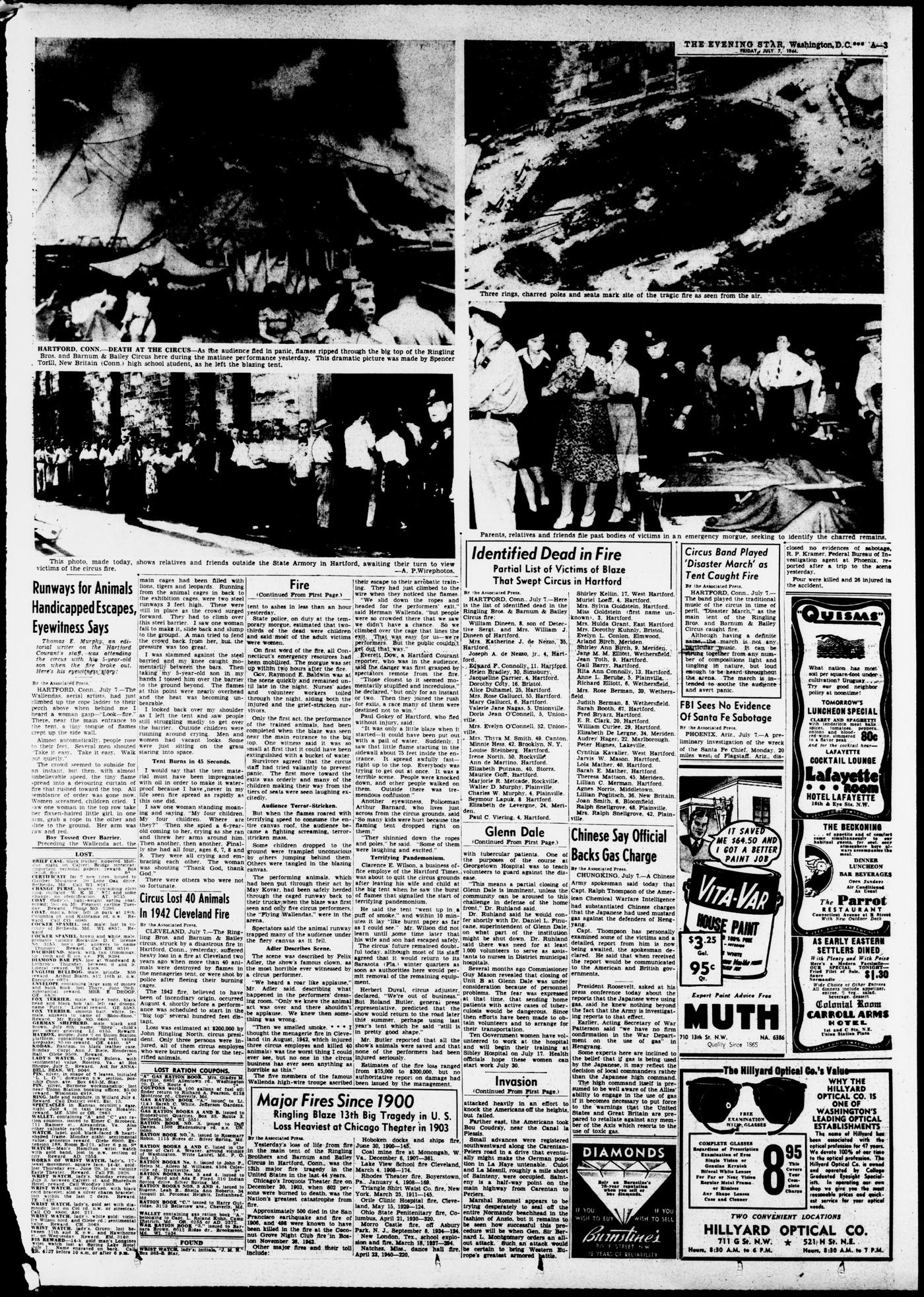
View the original at the Library of Congress →
The animal act had just finished. The five Wallendas — Herman, Carl, Joe, Helen and Henrietta — had climbed to their wire above the rings of the Ringling Brothers and Barnum & Bailey circus in Hartford, Connecticut, on the afternoon of Thursday, July 6, 1944, when a flame appeared in the sidewall of the tent near the main entrance.
Thomas E. Murphy, an editorial writer on the Hartford Courant, was in the audience with his five-year-old son, and his account of the next minute ran on the Associated Press wire. Behind him, he wrote, he heard a woman gasp — “Look—fire.” Several men shouted “Take it easy. Take it easy. Walk out quietly.” The crowd seemed to subside for an instant. Then, in his words, “with almost unbelievable speed, the tiny flame spread into a devouring curtain of fire that rushed toward the top. All semblance of order was gone now. Women screamed, children cried.” The subhead over his account said the tent burned in forty-five seconds. The United Press put the audience at 10,000; the Associated Press account said 6,000. The Associated Press also carried a boxed item under the headline “Circus Band Played ‘Disaster March’ as Tent Caught Fire” — the traditional signal, played until the burning canvas came down on the bandstand.
Herman Wallenda came down a rope and lived. “Then we carried out bodies—so many bodies,” he told the United Press. “I went back for more the last time when a man called to me and asked me to help him pull out his child. He called from the grandstands, and I reached up toward him—he fell back into the fire.” His sister Helen fell in the crowd — “I fell and they stepped on me,” she said — and was pulled out by an usher after a child pointed her out. “People always looked up at us,” Herman said. “I can never look down at a crowd again without smelling the flames and burning flesh.”
The next morning the Waterbury Democrat, the nearest daily in the reachable record, thirty miles away, stacked two banner headlines at the top of its front page. The upper one read “YANKS TAKE AIREL, RAIL CENTER.” The lower one read “CIRCUS DEATH TOLL REACHES 146 TODAY.” The war in Normandy above; the fire in Hartford directly beneath it.
The dead, named
The United Press called it the worst fire in circus history, and its first-morning accounting was exact in the way only a morgue ledger is exact: of the sixty-one bodies still unidentified on July 7, “13 boys, 11 girls, five men, 31 women, one baby.” State police at the morgue estimated, in the Associated Press account, that two-thirds of the dead were children and most of the adult dead were women.
The toll was a moving number. It was 146 on July 7, 152 on July 8, 160 when the coroner’s inquest opened on July 11, 163 by July 17 — the day the Washington Daily News reported the death of Rosalyn Kruh, who was twenty-two — and from late September the papers printed 168, the count that held for the rest of the year. The deaths were still being reported months later: in November an award was accepted on behalf of Edwin G. Woodward, dean of the University of Connecticut’s College of Agriculture, who had died of injuries from the fire.
The Associated Press moved a list headed “Identified Dead in Fire — Partial List of Victims of Blaze That Swept Circus in Hartford,” and partial is what it was. It begins with a child: “William Dineen, 8, son of Detective Sergt. and Mrs. William J. Dineen of Hartford.” Names and ages, town after town — Hartford, Simsbury, Bristol, Unionville, Meriden, Plainville.
Behind two of the names on the lists was a birthday party. Regina and Joan Toth were at a Hartford funeral home by July 8, in twin coffins the United Press described as partly covered with roses and ribbons. “It was to be a party for them,” their aunt, Mrs. Mary Toth Grant, said softly — “they had their first permanents and went to their first circus.” A tiny gold locket was the only possible identification for the little girl her father found in the armory morgue. “Regina died in the hospital,” Mrs. Grant said, “but Joan never got out of the circus tent alive. She never would push anyone for fear of being rude.” The girls’ father, the paper noted, was an aircraft company worker. His wife lay in the municipal hospital under plasma injections and an oxygen tent. “She must not know our babies are dead,” he told relatives. “Louise must live—and Albert—we had such a nice family.”
In East Hartford, the Gazette counted six of its own dead, four of them from one family: Edith Budrick, who was nine, and Joseph Budrick, Jr., who was seven; their aunt, Mrs. Viola Ann Locke, and her daughter Elaine, who was six. The children’s mother, Mrs. Joseph Budrick, was still listed as missing a week after the fire. Their father was the projectionist at the town’s Eastwood Theater; Frank Locke, Elaine’s father, was the assistant projectionist. Miss Margaret Garrison, sixty-nine, a resident of the town for seventeen years, “active in church and fraternal work as well as civilian defense activities,” died at the fire, and so did Mrs. Hulda Grant of Mayberry Village. On July 11 the Associated Press carried a paragraph as far as Juneau, Alaska: six of the dead, three children, two women and one man, would never be identified, and the mayor of Hartford announced they would be buried in individual graves.
The United Press called the State Armory “a house of death today” — the dead lay there on narrow Army cots under olive-drab blankets, and police and soldiers stood guard through the night. “If it weren’t for the children,” one of the soldiers said, “it would be easier to take. It’s the children that get you. Some of those kids are so badly burned they’ll never be sure who they are.”
The machinery
The Associated Press put it plainly: “On first word of the fire, all Connecticut’s emergency resources had been mobilized. The morgue was set up within two hours after the fire.” Governor Raymond E. Baldwin was at the scene quickly and stayed late into the night.
In East Hartford, the Gazette’s press-time bulletin recorded that every ambulance service in town was dispatched: private ambulances, those of the Red Cross Motor Corps, auxiliary equipment ambulances, and the United Aircraft ambulances. First-aid stations were opened at St. Mary’s School and the East Hartford High School. James Owens of the Gazette staff phoned back from the scene, in the paper’s words, that “police, soldiers, firemen, priests, doctors and nurses were carrying off dead and injured and using all types of trucks for conveyances.” The manager of the town’s Coca-Cola bottling plant, D. Page Bennett, got his own children clear of the tent, then ordered emergency first-aid equipment installed in several of his trucks and drove back to help.
Bradley Field, the Army air base at Windsor Locks, told its own part in its own paper, the Bradley Beam. On the Hartford police chief’s call for medical aid, the base dispatched a Mobile Evacuation Unit — two officers, two medical officers, twenty enlisted men, two ambulances — and distributed twelve doctors and twelve nurses from the base hospital among three Hartford hospitals. “Blood plasma, oxygen tents and other medical supplies were also rushed to the city.” A captain and a group of military police helped keep order at the grounds; an officer and twenty-four enlisted men of the 121st Base Unit carried bodies.
Waterbury sent nurses; two of them, the Democrat noted, “already have been commissioned in the U. S. Navy and are scheduled to report for duty next Tuesday.” And from Boston, at Governor Baldwin’s request, came Medical Examiner William J. Brickley and what the United Press called “a crew of experts, veterans of the Cocoanut Grove Holocaust.” The credential the wire gave for them: their civil-defense committee’s method for tabulating and identifying the dead of possible air raids, which at the night-club fire in 1942 had identified all 490 dead within four days. Inside the armory, a card system matched descriptions to the tagged dead; Salvation Army women passed out coffee and sandwiches to the volunteers, and a Red Cross rolling kitchen served the line of families waiting outside.
The town of the extra
The East Hartford Gazette was a weekly, and by early Friday morning its newsboys were selling an extra.
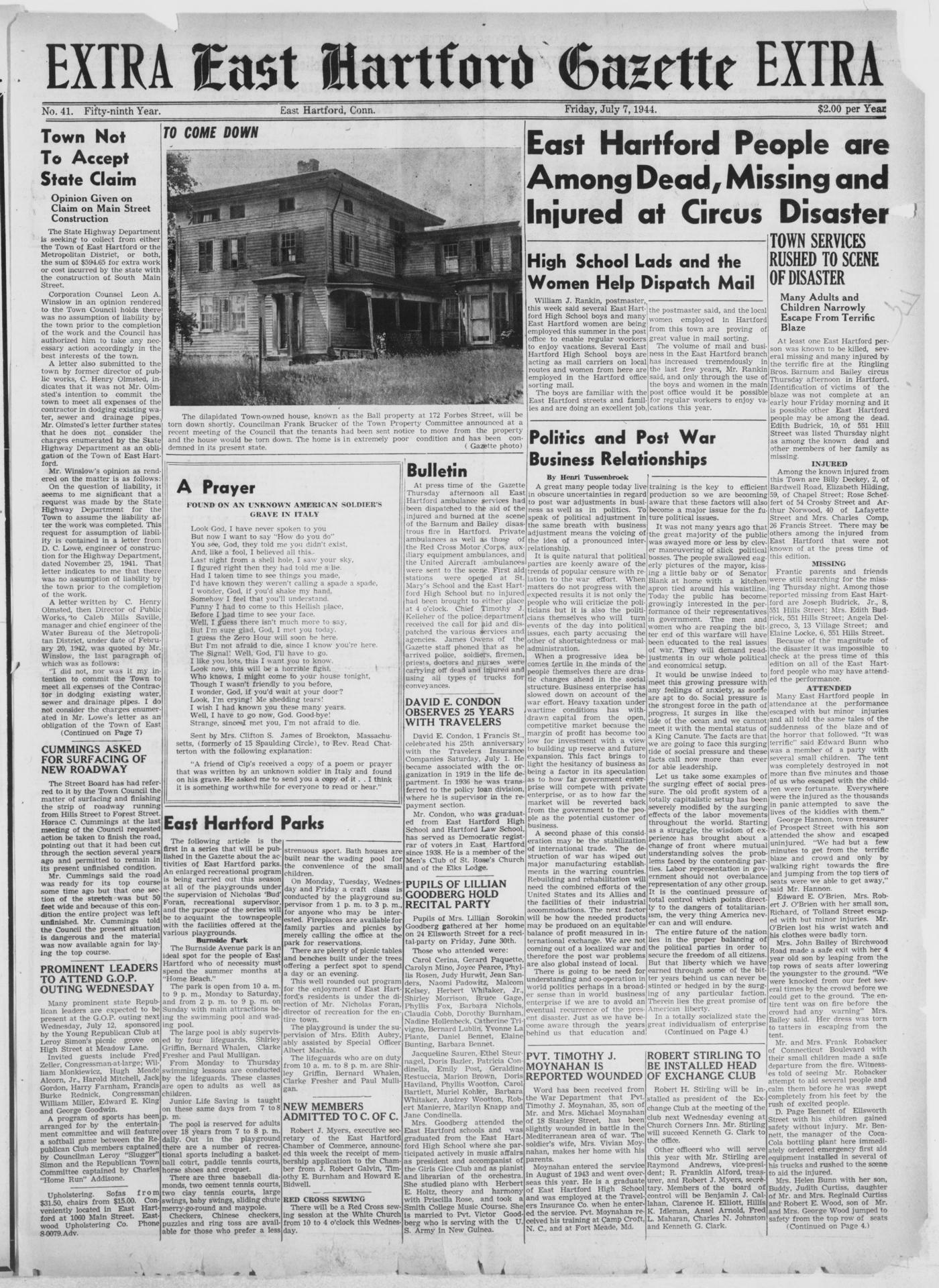
“East Hartford People are Among Dead, Missing and Injured at Circus Disaster,” the front page said, over the first names of the dead and missing and a column of townspeople’s escapes. George Hannon, the town treasurer, got out with his son: “We had but a few minutes to get from the terrific blaze and crowd and only by walking right towards the fire and jumping from the top tiers of seats were we able to get away.” Mrs. John Bailey lowered her four-year-old to the ground and leapt after him from the top rows. “We were knocked from our feet several times by the crowd before we could get to the ground. The entire tent was on fire before the crowd had any warning,” she said. Her dress, the paper noted, was torn to tatters. On the same front page stood the week the extra interrupted: the Fifth War Loan drive at sixty per cent of the town’s quota, and a prayer reprinted from the grave of an unknown American soldier in Italy.
The extra sold out. The following week the Gazette apologized to the townspeople it had to turn away: almost 2,000 copies had been printed, “and it was impossible to add to this number because of government paper restriction.” The trade paper Publishers’ Auxiliary took note, in a front-page story, of the Connecticut weekly that had issued an extra on the disaster.
The law moves
The arrests came within twenty-four hours. After a night of questioning canvasmen, performers, roustabouts and spectators, the police court prosecutor arrested five circus officials on manslaughter charges: James A. Haley, vice president; George W. Smith, general manager; Leonard Aylesworth, boss canvas man; Edward Versteeg, chief electrician; and David W. Blanchfield, chief wagon man. They spent the night in the Hartford city jail and were arraigned the next morning — bail of $15,000 for Haley and Smith, $10,000 for the others, cases continued to July 19. All five were silent in court; the United Press noted that photographers popped off scores of flash bulbs in the courtroom.
Police Prosecutor James F. Kennedy told the United Press the five had been charged on evidence of “gross negligence.” The circus’s own fire department, he said, had been “impotent.” He went further: “The menagerie here was set out in such a way that it partially blocked the main entrance to the big tent,” he said, “and the circus management apparently showed no interest in the safety of its patrons.” As to cause, he predicted it would take three months to establish, if it ever was, and advanced a theory of spontaneous combustion. Mayor William H. Mortensen’s investigating committee issued a public statement charging that the tent, the largest in the world, “had been sprayed with paraffin which had been melted in gasoline.” State’s Attorney Hugh M. Alcorn, Jr., put the same fact in his own formal statement, reported by the Associated Press: “There is also in our possession,” he said, “information that the tent itself had been in use only since the road show started this season and that it had been treated with paraffin which was diluted with gasoline, making the entire tent highly inflammable.” There had been, he said, “inadequate fire fighting equipment” on the grounds, manned by “inadequate personnel.” Six ushers told the state fire marshal the fire began with a carelessly thrown cigarette against a sidewall; he took them to the grounds, and their story, he said afterward, stood up under oath. Paraffin and gasoline, a cigarette, spontaneous combustion — the papers of that week left the cause contested and open.
Haley, the vice president, gave the United Press an interview while he was being fingerprinted. “I don’t know what caused the fire,” he said. “They have grilled me here since yesterday afternoon and I tried to help.” And then: “Does it do any good that I would have given my life to prevent the fire?”
On July 11, Coroner Frank E. Healy opened his inquest — a secret proceeding, expected to run for weeks, with a state police officer guarding the door and a stack of photographs of the fire on the hearing table. The five accused men were excused from the first session on the application of their counsel, who was William L. Hadden, the sitting lieutenant governor of Connecticut.
What kept working
The rest of 1944 is follow-through.
In August the state police commissioner ordered the Gem theater in Naugatuck shut at once, declaring it “unsafe for public assembly” — an action the Waterbury Democrat’s Naugatuck correspondent tied directly to the circus fire, reporting that the state police had instituted a thorough check of theaters since the tragedy. The same week, the circus’s special representative wrote a letter to East Hartford’s health officer, printed in full in the Gazette, thanking the town for its help.
In September a Hartford Chamber of Commerce committee delivered a seventeen-point fire-prevention report to the city’s corporation counsel. Its committee chairman, John Ashmead, said “there is little hope at this time of adopting, for tent purposes, a fabric that is inherently fire resistant.” The report’s judgment on July 6 was quotable and cold: “the fire hazards surrounding the audience were no different from those found in the spectators’ homes,” it found, and the exits should have let twice the crowd out in under four minutes — “However, the safeguards provided proved inadequate for the hazards involved.” It proposed more exits, a separation of 250 feet between the main tent and any other enclosure, metal seating in place of loose chairs, and animals exhibited in the open. The same United Press story noted that the coroner’s investigation into the cause “has not yet been concluded.”
In October the national Office of Civilian Defense conferred Citations for Merit on the Connecticut War Council and the Hartford War Council for their handling of the disaster, voted on the reports of the OCD’s own observers. The state council’s staff had manned the emergency morgue at the armory; the thousand or more Hartford volunteers — ambulance drivers, nurses’ aides, air raid wardens, messengers, telephone operators — were entitled to wear a Citation of Merit lapel pin showing a capital “M.”
In November, a municipal board of inquiry completing its investigation disclosed that at least two city detectives had seen the fire start in the main tent and hesitated to give an alarm for fear of causing panic. Four detectives had been at the main entrance, the board’s report said, “in search of a parolee among the circus personnel,” and later “reported to their superiors that they saw the fire in its incipient stages.” The board noted it was not its function to weigh criminal or civil liability. That same month the East Hartford air-raid wardens met to reorganize as a Civilian Service Corps — in the Gazette’s description, a continuation of the air-raid-warden setup from the beginning of the war, now to serve “in time of disaster.” And on a Sunday in early November, the Red Cross Motor Corps women who had worked the fire went back to the hospital wards where the burned still lay — four months on — with games, books, ice cream, and “movies of local events and Donald Duck comedies, with which the children were highly entertained.”
The civil claims were settling out of court. The Hartford Courant — reachable in this record only where another paper reprinted it — welcomed, in an editorial the Waterbury Democrat carried in its Views of the Press reprint column, the arbitration agreement drawn up between the Hartford County Bar Association and the circus’s counsel: “Our courts will not be clogged with interminable litigation if the arbitration agreement is accepted.” By Christmas week a Waterbury columnist was quoting the circus’s own 1944 route book, sent out by its press department, on what the year had cost: “We’ve mortgaged the show’s future profits to pay off all just claims to the last cent and until that last cent is paid, Ringling Brothers and Barnum & Bailey will have an office here (Hartford).” The columnist added — the claim is his, not the book’s — that a million dollars had already been deposited to meet claims, and noted that the book closed with “The Show Must Go On.” In its own year-end review, the East Hartford Gazette set the fire where the town’s year had put it, in one sentence with the war dead: sorrow had come to many East Hartford homes from the circus fire in July, and from the number of East Hartford boys who had given their lives on the battle fronts of Europe and the Pacific.
The criminal case did not resolve. In late October the United Press reported that, because the fire marshal and the coroner had not completed their investigations, the superior-court trial of the five circus officials on manslaughter charges — growing out of a fire the same dispatch now counted at 168 dead — had been put over until the January term. That is where the year left it: the investigations still open, the five men untried, and the question their arrest had posed in July carried forward into 1945.
The pages of the Waterbury Democrat, the Evening Star, the East Hartford Gazette, the Wilmington Morning Star, the Washington Daily News, the Daily Alaska Empire, and the Bradley Beam are shown or linked above from the Library of Congress, which states it is not aware of any U.S. copyright restrictions on them — an institutional assertion rather than a statutory public-domain guarantee. No Hartford daily newspaper is digitized in Chronicling America: the city where the fire happened cannot be read in its own papers here, and Hartford voices reach this record only secondhand — through wire copy (the Courant editorial writer Thomas E. Murphy’s account ran via the Associated Press) and through reprints (the Courant’s arbitration editorial survives here as reprinted in the Waterbury Democrat). Nearly all fire coverage cited is United Press or Associated Press wire copy; a single filing printed in many papers is treated as one source throughout. The death toll is reported as the papers’ own count with dates — 146 through 163 across July, 168 in print from late September — and the injury figures varied by wire and day; one October injury figure is omitted because a digit is unresolvable on the scan. Victims’ names and ages are given exactly as the cited list or story printed them; the period lists disagree on some spellings (Snellgrove/Snelgrove, de Nezzo/De Nazzo among them), the Associated Press list was headed “partial,” and no attempt is made here to regularize either. Several pages carry printed compositor’s errors (transposed letters in three places); this article leaves them uncorrected on the page and avoids them by quote boundaries rather than reproducing or silently fixing them. No staged page ties a named victim to a serviceman overseas, and no such connection is asserted. The five officials’ trial was put over to the January 1945 term, which falls outside the staged record; its outcome is not narrated here. The coroner’s findings never surface inside the staged window. The search for the post-July record covered two titles — the Waterbury Democrat and the East Hartford Gazette, August through December 1944, ten search terms — so an absence noted here is an absence from that search, not evidence that something went unreported.
“A House of Death Today,” The Evening Star, July 7, 1944, p. 3. Library of Congress, Chronicling America. loc.gov/resource/sn83045462/1944-07-07/ed-1/?sp=3