Simply Out of Luck
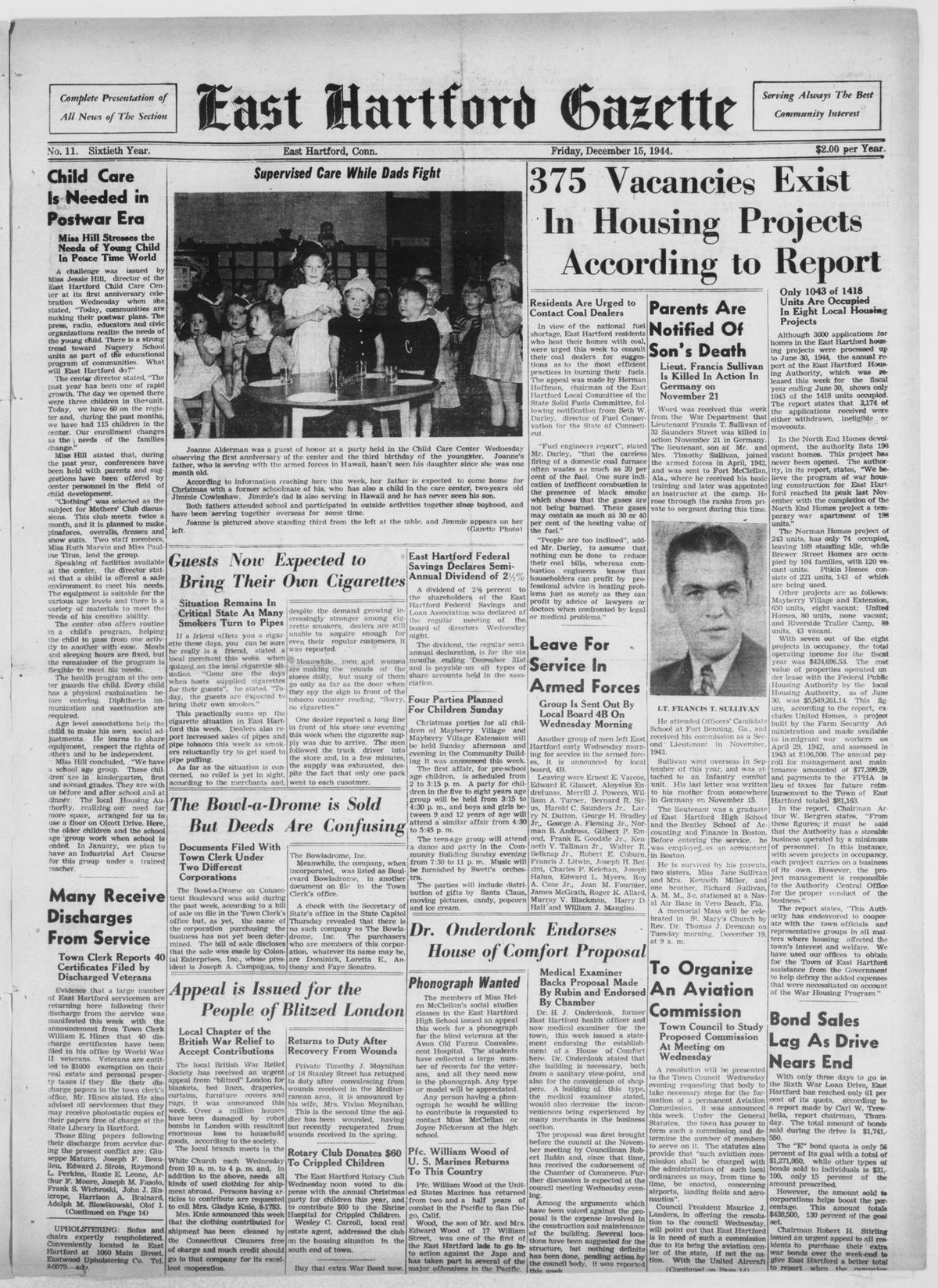
In the winter of 1944 the East Hartford Gazette reported that a boom town could not buy cigarettes. There was no ration book for them, so the shortage went by advantage — connections, cash, standing — and the clerk behind the counter decided who counted as a regular. The war workers who had come to build the airplanes were, the paper wrote, simply out of luck.
View the original at the Library of Congress →
“Sorry, no cigarettes today.” By the winter of 1944, smokers in East Hartford, Connecticut, had been greeted with that statement, the East Hartford Gazette reported, “more and more frequently during the past month, and this week the situation grew more critical than ever.” Men and women made the rounds of the stores daily; many went only as far as the door, where a card on the tobacco counter told them what the clerk did not have. Dealers, asked why, said only that they “just can’t get any.” The cigarette machines wore small signs: “No Cigarettes.”
There was no ration book for it. Sugar, meat, coffee, gasoline — those a civilian bought with stamps, in amounts the government fixed. Cigarettes were never rationed. The shortage came from somewhere up the line — the Gazette called it a “bottle-neck” — and the rest was left to the market. A shortage with no rules is settled by advantage. A man told a dealer he had enough at home to last him until May; asked where he got it, he said it was “being shipped here from New Jersey.” An irate customer, refused, offered thirty-five cents for a pack: “you can give a bootblack in Hartford 35 cents,” he said, and the boy would disappear and come back with your brand. The bottleneck reached, the paper noted, “even in local war plants” — the plants that had drawn the town’s newcomers could not get cigarettes either.
The shortage rearranged small courtesies. “Gone are the days when hosts supplied cigarettes for their guests,” a local merchant told the Gazette. “Today, the guests are expected to bring their own smokes.” Smokers turned, reluctantly, to pipes. When a delivery was due one evening, a line formed; the men followed the truck driver into the store, and in a few minutes the supply was gone — one pack to a customer. Tempers went with it. In one store, the paper reported, a man refused cigarettes “nearly lost his head” and “yanked” a cigar from the mouth of the dealer, and would have gone further had other customers not walked in.
Then the question no ration book had answered: when there is not enough, who gets it? On February 23, 1945, the Gazette’s editorial page took it up, and found the government at odds with itself. New York’s OPA, the paper reported, had warned merchants that cigarettes “must not be kept for regular customers, but must be available to the general public.” Connecticut’s OPA said it did “not have the authority to force dealers to make sales in any particular way.” The state declined to order that cigarettes be kept on display until the supply ran out. Two states, opposite answers, the same month — and no rule.
So it fell to the man behind the counter, and in East Hartford he looked after his own. “The present system in most local stores,” the editorial wrote, “is keeping the old residents of the town well supplied. However, the newcomers to town, who have not established a regular business with the stores, are simply out of luck.” The newcomers were the war workers — the Gazette called them “in-migrant war workers” — who had come to build aircraft at United Aircraft, the boom that had made East Hartford, in the paper’s phrase, “the aviation center of the state, if not the nation.” They had helped build the war, and they could not buy a cigarette. “Merchants,” the editorial argued, “should take these people into consideration.”
The same front page urged residents, “in view of the national fuel shortage,” to see their coal dealers, and reported the town’s war-housing projects standing 375 units empty. A boom town could put up houses ahead of the people; it could not make the trucks bring more cigarettes. (It was not only tobacco, either — the grocers’ ads reserved “the right to limit quantities.”)
The crisis eased without ending. By the following July the Gazette reported that the less popular brands were plentiful again, but that “in spite of the shortage, smokers are refusing to accept brands other than their favorites in many cases.” The line at the counter shrank to a grumble about taste. The paper never ran the words the shortage is over.
There is no one at the center of this. The merchant is “a local merchant”; the editorial is unsigned; the man who yanked the cigar has no name. That is what a shortage looked like from a small paper in a boom town — nobody in charge, everybody affected, and a clerk deciding, one pack at a time, who counted as a regular.
Everything here is drawn from The East Hartford Gazette (East Hartford, Connecticut) — the issues of December 1 and December 15, 1944, February 23 and July 13, 1945, and a grocer’s advertisement of December 22, 1944 — all public-domain and digitized in the Library of Congress’s Chronicling America collection; the front page shown is self-hosted and the link points to the original. This piece has no protagonist by design: the shortage was reported through an unnamed “local merchant,” an unsigned editorial, and the notices on the counters, and that is faithful to what the record holds — a scarcity nobody administered and everybody felt. The three Office of Price Administration positions (New York’s, Connecticut’s, and the state’s) are given as the Gazette reported them, in its own words, not as direct quotations of any official. That cigarettes were never federally rationed — unlike sugar, meat, coffee, and gasoline — is the settled record of wartime rationing, and is borne out on the page by the Connecticut OPA’s own statement that it lacked the authority to make dealers sell in any particular way; with no ration mechanism, distribution fell to the merchant. The newcomers are named only as the paper named them, “in-migrant war workers” at the United Aircraft plants; the reachable record does not give their origins, and this account does not supply any.
“Simply Out of Luck,” The East Hartford Gazette, December 15, 1944, p. 1. Library of Congress, Chronicling America. loc.gov/resource/sn85009852/1944-12-15/ed-1/?sp=1